
New Delhi: India has taken a significant step forward in Green Hydrogen Mobility with the launch of a new pilot project jointly undertaken by the National Institute of Solar Energy (NISE) and Toyota.
Union Minister for New & Renewable Energy, Pralhad Joshi, inaugurated the initiative in New Delhi, describing it as a major advancement in India’s transition to clean transportation technologies.
Green Hydrogen Mobility Pilot: Key Milestone in Clean Transport Vision
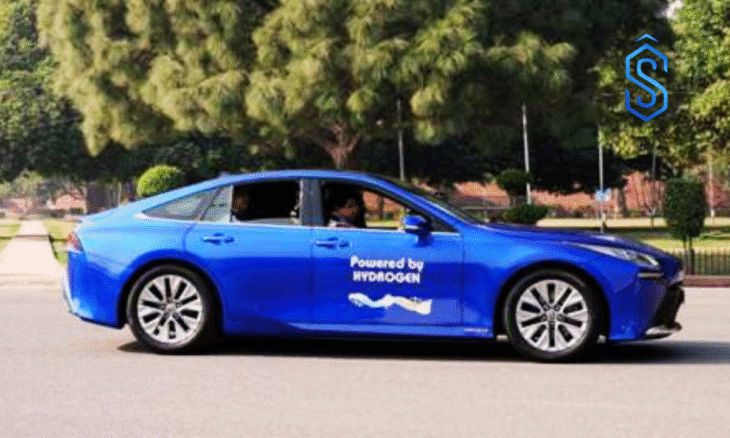
Pralhad Joshi highlighted that green hydrogen is rapidly emerging as the backbone of future global energy systems. Under the collaboration, Toyota Kirloskar Motor handed over its Mirai hydrogen fuel cell electric vehicle (FCEV) to NISE for comprehensive real-world trials.
The Minister said this partnership brings together innovation, industrial expertise and scientific evaluation to accelerate India’s adoption of clean, low-emission mobility solutions.
Also Read: Hydrogen Train Project: Green Hydrogen Plant Planned at Jind
He added that such initiatives reinforce India’s “Energy Aatma Nirbharta” goals and support the nation’s Panchamrit climate commitments.
Calling the Toyota Mirai a “new chapter for sustainable mobility,” he noted that its name – meaning “Future” in Japanese – reflects India’s long-term vision for a greener mobility ecosystem.
NISE to Lead Two-Year Evaluation to Advance Green Hydrogen Mobility Research
As part of the MoU, NISE will undertake an in-depth, two-year assessment of the Mirai’s performance under varying Indian road and climatic conditions, including high temperatures, dust, congested traffic and uneven terrain.
The results are expected to generate valuable technical insights necessary to scale up Green Hydrogen Mobility across the country.
The Minister emphasized that hydrogen fuel cell vehicles, which emit only water, are quiet, clean and increasingly used worldwide across mobility and power sectors. He said personally driving the hydrogen vehicle demonstrated its readiness and suitability for Indian roads.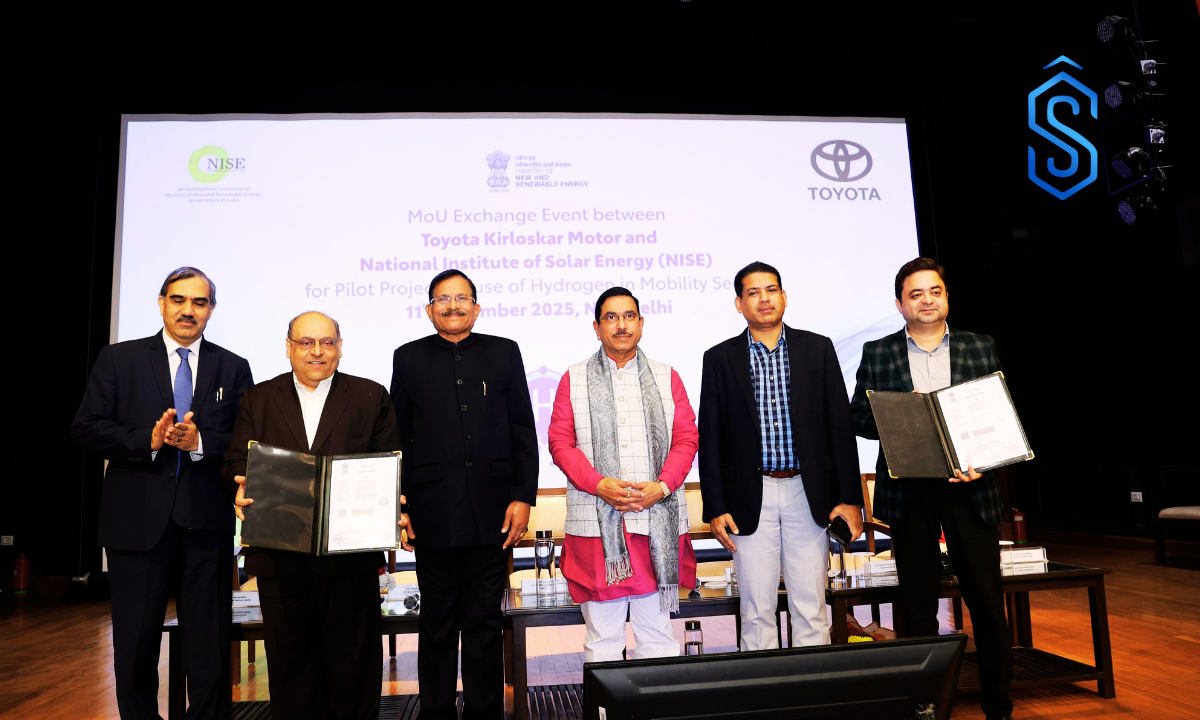
Shri Joshi commended Toyota Kirloskar Motor for its commitment to carbon neutrality and praised NISE for its leadership in advancing India’s renewable energy goals.
Minister of State for New & Renewable Energy, Shripad Yesso Naik, described the initiative as a major stride toward a clean, self-reliant energy future. He noted that since the launch of the National Green Hydrogen Mission in January 2023, India has moved swiftly from policy frameworks to real-world experimentation.
He highlighted that the Green Hydrogen Mobility pilot involving the Toyota Mirai will offer crucial insights needed for eventual commercialization of hydrogen-based mobility solutions. The Minister also applauded the collaboration between industry, research institutions and the government in strengthening the country’s hydrogen ecosystem.
Also Read: Plasma-Activated Coordination Polymer Electrocatalysts Boost Clean Hydrogen Production
Toyota Reiterates Support for India’s Green Hydrogen Mobility Ambitions
Vikram Gulati, Country Head and Executive Vice President, Toyota Kirloskar Motor, said the partnership with NISE reaffirms Toyota’s commitment to supporting India’s Green Hydrogen Mission.
He stated that hydrogen fuel cell technology will play a critical role in helping India meet its net-zero targets and energy independence goals.
Senior officials including Santosh Kumar Sarangi (Secretary, MNRE), Dr Mohammad Rihan (Director General, NISE) and Abhay Bakre (Mission Director, National Green Hydrogen Mission) were also present.
The Toyota Mirai is a second-generation hydrogen fuel cell electric vehicle (FCEV) that generates electricity through a chemical reaction between hydrogen and oxygen, producing only water vapour as emissions.
With a driving range of nearly 650 km and a refuelling time of less than five minutes, it is considered one of the world’s most advanced zero-emission mobility solutions.